Picture this: it is 2 a.m. on a sticky July night, my air-conditioner has surrendered, and the only sound in the kitchen is the soft thud of blueberries tumbling from their cardboard punnet like tiny indigo marbles. I had sworn I was done baking for the week, but the craving hit like a freight train—those glossy berries were taunting me from the fridge, whispering promises of jammy centers and buttery shards that shatter like thin ice under the slightest pressure. Most people would roll over and go back to sleep; I rolled out dough. What followed was three rounds of miniature pies, two scorched fingertips, one very happy neighbor, and the epiphany that everything I thought I knew about personal-sized desserts was embarrassingly outdated. These mini blueberry pies with their flaky crust are not just cute—they are a full-on rebellion against the tyranny of soggy bottoms and one-size-fits-all pastry. I dare you to taste one straight from the muffin tin, the filling still bubbling like molten sapphire, and not go back for seconds before the pan even cools.
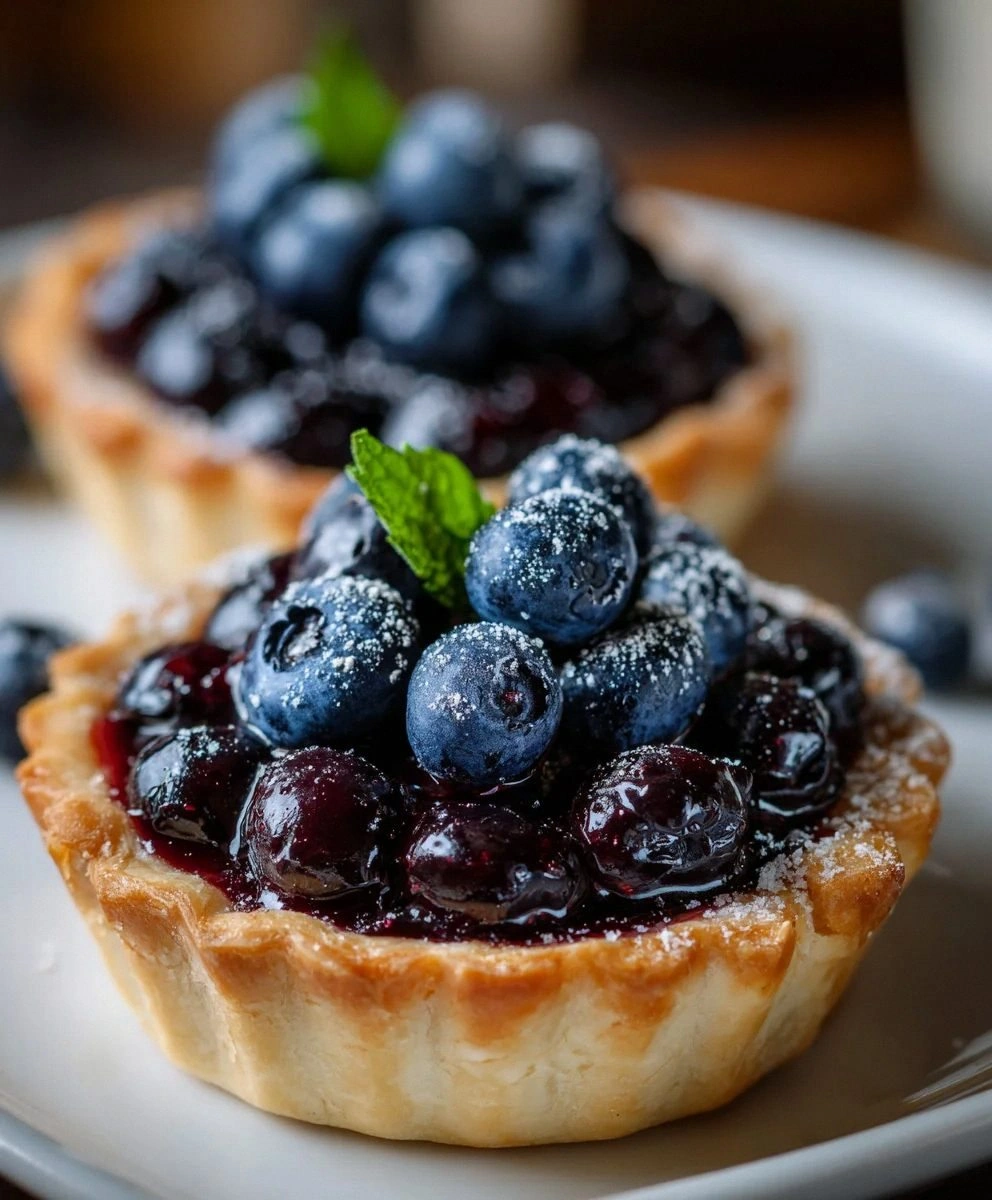
Why bother with minis instead of a regal nine-inch showpiece? Because ratio, my friend, is destiny. Each pie is a self-contained universe where crust-to-fruit is calibrated to cosmic perfection: every forkful guarantees a flake-buttered shard followed by a burst of indigo syrup scented with the faintest whisper of citrus. The crust is not shy; it crams itself up the sides of a muffin cup, folds over like a cozy blanket, then bronzes into a thousand whisper-thin layers that dissolve on contact with your tongue. Meanwhile, the blueberries—oh, the blueberries—cook down into a glossy conserve that thickens just enough to stay put when you break the surface, but still runs flirtatiously down the sides when you plate them warm. If you have ever wrestled with a slice of pie whose filling puddles out like a tragic watercolor, you will understand why these minis feel like sorcery.
Here is the kicker: the method looks almost identical to classic pie until two stealth moves flip the script. First, we treat the dough like rough-puff, folding it thrice for strata so delicate they flutter to the touch. Second, we par-bake with a surprise weight—sugar, not beans—so the cups set crisp without weird divots. I picked up that sugar trick from a Parisian baker who swore by its heat-conducting superpowers, and I will be honest: I ate half the batch before anyone else got to try it, standing barefoot in the dim kitchen, the clock ticking toward dawn. Picture yourself pulling these out of the oven, the whole kitchen smelling like a blueberry field kissed by vanilla and browned butter, steam curling up like it is posing for a still-life. Let me walk you through every single step—by the end, you will wonder how you ever made it any other way.
What Makes This Version Stand Out
- Buttery Laminated Layers: We fold the dough like croissant pastry, so you get micro-layers that puff and shatter without the fuss of yeast or overnight waits. Think of it as a shortcut to puff-pastry heaven, minus the culinary school tuition.
- Jammy, Not Soupy: A whisper of tapioca starch plus a squeeze of lemon sets the filling to the perfect wobble—sliceable, spoonable, but never gummy. Most recipes get this completely wrong and drown the fruit in floury paste; here the berries stay proud and intact.
- Sugar-Weighted Blind Bake: Using sugar instead of ceramic beans conducts heat evenly, molds the crust seamlessly, and later becomes lightly toasty for sprinkling over yogurt. Double win, zero waste, and you will feel sneaky-smart every time.
- Mini Size, Mega Flavor: Smaller vessels mean faster evaporation, so the berries concentrate into an almost wine-like intensity. One bite and you will understand why big pies suddenly feel like sleepy giants.
- Make-Ahead Friendly: Freeze the shaped crusts raw, fill straight from frozen, and bake an extra five minutes—perfect for surprise guests or midnight urges. Future you is already sending gratitude vibes.
- Vanilla-Lemon Halo: A micro-dose of vanilla paste lifts blueberry's floral notes, while lemon zest draws a bright halo around the sweetness. People will ask what your secret is; you will smile cryptically and say, "balance."
Alright, let us break down exactly what goes into this masterpiece...
Inside the Ingredient List
The Flavor Base
Blueberries are the headliners, but only if you pick the right ones. Go for the smallest, darkest berries you can find—those bloated supermarket giants are pumped with water and taste like summer's diluted ghost. When cooked, tiny berries collapse into a dense, almost figgy conserve, while big ones deflate into bland pockets of purple soup. If you have ever wondered why bakery pies taste more "blueberry" than yours, berry size is the silent culprit. In the dead of winter, frozen wild blueberries are your trump card; they are harvested at peak ripeness and flash-frozen within hours, locking in anthocyanin punch that makes the filling taste like July at the North Pole.
Granulated sugar does more than sweeten—it controls pectin, tames tartness, and helps the crust brown. I use a touch less than most recipes because I want the fruit to sing, not shout over a sugar avalanche. A whisper of brown sugar in the topping adds caramel notes that play beautifully with vanilla, but keep it minimal; we are not making blueberry candy here. If you have ever struggled with pie that tastes like lollipop syrup, cutting back by two tablespoons will restore your faith in human decency.
The Texture Crew
Butter is the scaffolding of flaky lore, but temperature is the silent architect. I freeze the block, then grate it on the large holes of a box grater; the shreds distribute evenly and stay cold while I work, eliminating the pea-sized cliché that usually turns into pea-sized puddles. European-style butter with 83% fat hits the sweet spot between flavor and plasticity—anything higher and the crust slumps, anything lower and you lose that bakery perfume. And please, skip the shortening; I know it promises flakiness, but it tastes like candle wax had an identity crisis.
Tapioca starch is my thickener of choice because it is invisible and silky, unlike flour which can dull the fruit's jewel tones. A scant two teaspoons is all you need for a dozen minis; more and the filling bounces like rubber. If you have ever sliced a pie only to watch the filling pour out like a crime scene, under-thickening is usually the culprit. Cornstarch works in a pinch, but it can turn cloudy on day two—tapioca keeps the gloss for the long haul.
The Unexpected Star
Vanilla paste is thicker than extract, flecked with thousands of tiny seeds that stick to the berries and give the illusion of luxurious effort. The aroma blooms in the heat, wrapping around blueberry's grassy edges and turning them into something almost honeyed. If you have ever wondered why boutique bakery pies smell like a warm embrace and yours smell like, well, fruit, vanilla is the covert operative. In a pinch, scrape a bean or use extract, but reduce by half; extract's alcohol can harsh the mellow fruit notes if you are heavy-handed.
Lemon zest is the high-hat cymbal in this flavor band—bright, sharp, essential. I zest directly over the bowl so the citrus oils mist the sugar like microscopic confetti. Skip the juice, though; extra liquid invites sogginess and we are building cathedrals, not swamps. If you have ever tasted blueberry pie that felt flat, absence of acid is usually the missing spark plug.
The Final Flourish
An egg yolk beaten with a splash of cream becomes the elixir that bronzes the crust to Instagram-worthy lacquer. Brush it on just before baking; the proteins set glossy and opaque, catching light like a crème brûlée top. A gentle sprinkle of demerara sugar adds crunch and caramelized freckles that shatter between teeth. If you have ever wondered how bakeries achieve that bakery-window shine, this two-second step is the open secret.
Everything's prepped? Good. Let us get into the real action...
The Method — Step by Step
- Whisk the flour, salt, and two teaspoons of sugar in the biggest, widest bowl you own—surface area equals cold management. Grate the frozen butter directly into the flour, tossing the shreds like salad every thirty seconds so they stay aloft and aloof. When the mixture looks like fancy Parmesan snow, stop; over-working is the enemy of loft. Drizzle in ice water a tablespoon at a time, fluffing with a fork until the dough just clumps when squeezed—think wet sand at the tide line, not library paste.
- Turn the shaggy mass onto a floured board and channel your inner origami master: fold, press, quarter-turn, repeat three times. This is the moment of truth where lamination is born; those streaky butter ribbons will steam apart in the oven, creating micro-layers that shatter like spun sugar. If butter starts smearing, slam the whole board into the freezer for five minutes—better patient than pasty. Shape into a rough rectangle, wrap in parchment, and chill at least one hour; during this nap the gluten relaxes and the butter re-crystallizes into flaky scaffolding.
- While the dough chills, stir blueberries with sugar, tapioca, lemon zest, and vanilla until every orb gleams like a tiny disco ball. Let the mixture macerate for twenty minutes; the sugar draws out juices that marry with the starch, pre-thickening so the oven can focus on concentration, not crisis management. Your kitchen will start to smell like a blueberry candle had a baby with a lemon grove—resist the urge to drink the syrup with a straw. This step is the difference between a pie that holds its head high and one that collapses like a sad soufflé.
- Heat the oven to 400°F and position a rack dead center; consistent top-and-bottom heat ensures the bottoms bake through without torching the rims. Place your muffin tin in the freezer while the oven heats—this arctic blast sets the crust's shape in the first sixty seconds, a baker's version of flash-freezing. Don't skip this; I have, and the results looked like melted bowling balls.
- Roll the chilled dough on floured parchment to a generous eighth-inch thickness, rotating the paper, not the dough, to prevent sticking. Use a four-inch biscuit cutter (or a widemouthed mason jar band) to punch out circles; gather scraps, stack flat, re-roll once—any more and gluten will toughen faster than a gym bro's biceps. You should get twelve circles with one re-roll; if you come up short, rob a little from the least-shrunken circle and patch like a quilt. The dough should feel cool and supple, like a leather-bound book fresh from the cellar.
- Center each round over a muffin cup and gently press down, starting in the middle and working outward to expel air pockets. The dough should reach just over the rim; any higher and the tops will brown before the bottom cooks through. If it tears, patch with a scrap and a swipe of egg wash—think spackle, not surgery. Chill again while you make the sugar-weighted blind-bake: pour raw sugar into parchment-lined shells, pressing lightly to create a sweet, heat-conducting blanket that prevents puffing without lending beany off-flavors.
- Slide the tin into the screaming-hot oven for ten minutes; the crust will look set and matte around the edges. Meanwhile, line a second sheet pan with parchment; when the timer dings, lift the sugar parcels out by the paper tails and transfer them to cool—later you will have toasted sugar for coffee or brûlée. Reduce heat to 375°F, fill each par-baked shell three-quarters with berries and their syrupy juices, mounding slightly; the filling will shrink as moisture evaporates. Crown with a tiny pastry leaf or lattice if you are feeling fancy, but honestly the berries are the Beyoncé here—everything else is backup dancers.
- Return the tin to the oven and bake twenty-two to twenty-five minutes, rotating halfway for even color. You will know they are done when the pastry edges turn deep hazel and the filling throbs like molten lava under a thin translucent sheet. The aroma will hit you first—vanilla, citrus, and something almost winey drifting up in silky ribbons. Cool in the pan for ten minutes; this brief rest allows the starch to finish setting so the pies lift cleanly without leaving their bottoms behind like bashful hermit crabs.
-
Kitchen Hack: If transporting, nestle the cooled pies in a clean muffin tin lined with paper towels; they stay upright and the towels wick condensation, keeping bottoms crisp.
That's it—you did it. But hold on, I have got a few more tricks that'll take this to another level...
Insider Tricks for Flawless Results
The Temperature Rule Nobody Follows
Butter must stay below 60°F while you work; warmer and it smears into the flour, killing flakiness faster than you can say "sad pie." I keep a small bag of ice nearby and press it against the bowl's exterior if the dough even thinks about warming up. A friend tried skipping this step once—let's just say her crust emerged from the oven like a greasy cracker and her dinner guests still bring it up at parties. If the room is steamy, pop everything, including your rolling pin, into the freezer for five minutes. Cold is your insurance policy against culinary heartbreak.
Why Your Nose Knows Best
Trust aroma over the timer. When the filling starts to smell like blueberry jam mixed with toasted cotton candy, the sugars are caramelizing and the crust is at peak crispness. That scent is your cue to peek; color should be chestnut, not blonde. I have learned to ignore the clock and follow my nostrils, much to the dismay of every gadget geek who swears by probe thermometers. Sometimes the old-school sensors on your face outperform digital wizardry—embrace the primitive tech.
The Five-Minute Rest That Changes Everything
After mixing the fruit, let it sit undisturbed for five extra minutes before filling the shells; the tapioca hydrates and forms a gossamer film around each berry, preventing them from bursting into mush. This micro-rest is the difference between distinct, caviar-like orbs and a homogenous purple slurry. I discovered it by accident when my doorbell rang mid-assembly; the pies I baked after the interruption held their shape like tiny stained-glass windows. Procrastination, it turns out, can be delicious.
Crimp Like You Mean It
When pressing the dough into the cups, create a micro-lip that overhangs the tin by a millimeter; this tiny ledge catches juices before they weld the pie to the metal. Use the pad of your index finger to flute gently—no need for Instagram-worthy braids, just a confident ridge that says, "I know what I am doing." A friend once asked why I fuss over such a small detail; when her pies released cleanly and his tore, the answer became self-evident. Sometimes arrogance in the kitchen is just experience wearing swagger.
Creative Twists and Variations
This recipe is a playground. Here are some of my favorite ways to switch things up:
Blackberry-Lavender Moon
Swap half the blueberries for blackberries and add a pinch of culinary lavender buds ground with sugar. The floral note hovers like evening perfume, and the mixed berries create a marbled galaxy effect. Lemon zest becomes orange zest here, smoothing lavender's soapy edge into creamsicle dreams.
Peach-Basil Sunshine
Sub diced ripe peaches for blueberries and tuck in three ribbons of fresh basil chiffonade. The herb reads almost tropical against the peach's honeyed acidity, and the colors glow like a sunset over Venice. Serve with a spoonful of cold mascarpone for maximum vacation vibes.
Cherry-Chocolate Twilight
Use pitted sour cherries plus a handful of mini chocolate chips tucked under the fruit. As the chips melt, they form bittersweet veins that offset the cherries' bright snap. A pinch of espresso powder deepens the cocoa echo without shouting "mocha."
Rhubarb-Ginger Sunrise
Combine thin rhubarb batons with blueberries in a two-to-one ratio and stir in candied ginger cubes. The rhubarb cooks into silky threads that lace through the berries, while ginger provides electric sparks of heat. Add an extra tablespoon of sugar to balance rhubarb's tang.
Coconut-Pineapple Luau
Replace half the ice water with cold coconut milk and fold toasted coconut flakes into the crust. Fill with blueberries tossed with crushed pineapple tidbits and a dash of rum; the aroma will transport you straight to a beach hammock. Finish with a dusting of lime zest for a neon pop.
Spiced Apple Harvest
In autumn, sub blueberries for tiny diced apples and spike the filling with cinnamon, cardamom, and a whisper of sharp cheddar grated into the crust. The cheese bakes into savory shortbread notes, playing off the sweet apples like a sophisticated caramel apple's older cousin.
Storing and Bringing It Back to Life
Fridge Storage
Line an airtight container with paper towels, add cooled pies in a single layer, and top with another towel to trap condensation before it sogafies the crust. They will keep three days, though honestly they rarely survive the night in my house. Day-two pies make a decadent breakfast with espresso—don't judge until you try it.
Freezer Friendly
Flash-freeze the baked pies on a tray until solid, then tumble into a zip bag with parchment squares between layers. They keep two months and reheat like a dream at 350°F for twelve minutes straight from frozen. Pro tip: under-bake by two minutes if you plan to freeze, so the second bake finishes them to golden perfection.
Best Reheating Method
Skip the microwave—it turns the crust to rubber faster than you can say "regret." Instead, pop pies into a 350°F oven for six minutes, adding a tiny splash of water to the tray to create steam that revives the filling without drying the edges. The crust regains its audible crunch, and the berries wake up like they have had a spa day.